The World of TV: Nurturing or Malnourishment?
- Georges Léopold
- May 8, 2024
- 11 min read


With the click of a button, endless forms of content become available. From the Savannas of a National Geographic Safari, illustrious animals gallop across the open fields; you flip the channel, and the trenches of an apocalyptic world conflict swallow you whole, with gunfire ringing through the room. The television transports the viewer into a cinematic universe where seemingly anything goes. Thus, television has a behavioral and ideological influence on cultures on a global scale, influences that connect our vast world.
Renowned American author and media critic Neil Postman argues in his seminal work Amusing Ourselves to Death that television's emphasis on entertainment trivializes public discourse, eroding critical thinking skills and fostering passivity. “What is happening here is that television is altering the meaning of ‘being informed’ by creating a species of information that might properly be called disinformation…misleading information—misplaced, irrelevant, fragmented or superficial information—information that creates the illusion of knowing something but which in fact leads one away from knowing” (Postman 93). In the eyes of Postman, television is synonymous with irrelevancy. The TV is merely spoon-feeding the viewer information, most of which is redundant and false.
There is absolutely no doubt about the societal impact of television; it’s everywhere; it’s in our homes, our classrooms, our restaurants, and oddly enough, in some bathrooms. Postman’s illustration of a world dominated by television isn’t a world far away from ours, which we already live in. Although Postman brings up several good points about the misinformation spread through TV, its cultural significance cannot be understated. This begs the question, is television assisting in societal nourishment or leading us to malnourishment?
Answering this isn't straightforward. Television acts as a double-edged sword; its effects on unifying societies, spreading information, and creating connections with on-screen personalities significantly influence our daily lives, for better or worse.
To further exemplify television's societal impact, By the late 1990s, according to the Grolier Encyclopedia, “98 percent of U.S. homes had at least one television set, and those sets were on for an average of more than seven hours a day,”. Based on this information, it’s impossible to deny that television has existed in nearly everyone’s lives. After a long, hard day in the summer sun, sitting on a comfy couch, wrapped in a blanket, and watching a movie was a ritual practiced every night in my childhood home. From action films of brave warriors fighting to save the world from impending doom to coming of age comedies filled the cozy room with awe and laughter. These are some of the memories that I hold most dear to me, memories that will never cease to move me.
Throughout our recent history, television has brought billions of people together, collectively watching the same programs and being transported into the realm of film. Since its inception, TV has been a tantalizing figure in history. It commands the attention of its viewers for several hours of the day. Studies have even proven that time spent in front of television allows people to grasp the events that affect the world around them, connecting them to the world around them and generating opinions and attitudes, contrary to Postman's claims. According to the Television in American Society Reference Library, “It (Television) influenced how people think about important social issues such as race, gender, and class. It played an important role in the political process, particularly in shaping national election campaigns.” (Encyclopedia.com.) Through TV, billions can express and hear opinions, creating an environment of world education and self-analysis.
During the Cold War, freedom of speech, especially in media, was hotly debated as the Red Scare engulfed the United States. In March 1954, journalist Edward R. Murrow broadcasted unsavory opinions of U.S. Senator Joseph McCarthy on his show See It Now. The program gave Murrow a medium to connect to the American people about a pressing issue: radical proposals to deal with a potential Communist infiltration. As a result of this program, the uproar surrounding McCarthyism eventually led to his recrimination by the U.S. Senate, a significant win for free speech and expression in America. (University of Minnesota). This laid out the catalyst for what would become opinion-oriented television. In the program, Murrow stated,
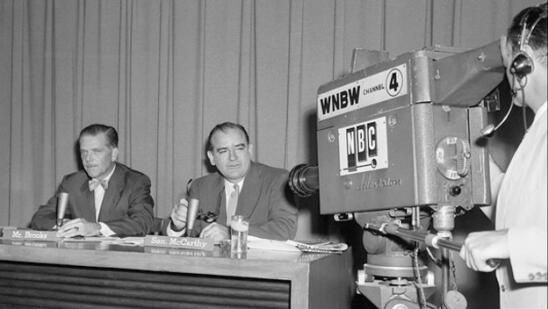
Photo: McCarthy Questioned on Anti-Communist Investigation (NBC)
“The actions of the junior Senator from Wisconsin have caused alarm and dismay amongst our allies abroad and given considerable comfort to our enemies. And whose fault is that? Not really his. He didn’t create this situation of fear; he merely exploited it – and rather successfully” (See it Now). The heroic actions taken by Murrow generated opinions worldwide on the issue of Communism. Still, more importantly, it birthed the concept of opinion-based television programs, many of which millions of Americans tune into daily over breakfast, generating buzz around political and social topics. These actions united the American People against the idea of a communist takeover; America’s fear of communism had been quelled.
However, none was more uniting than the United States’ Moon landing in 1969, another competition with the USSR.
From 240,000 miles away, millions worldwide needed to see this incredible moment, which was just one of the challenges of sharing the experience. The medium was television. Some 650 million viewers tuned in to see Neil Armstrong take humanity’s first steps on a foreign celestial mass. Of the 3.5 billion people alive in 1969, 17% of the population united in witnessing history regardless of age, gender, religion, skin tone, or nationality (Science and Media Museum). “I remember watching the Moon landing in school... It was difficult to make out as it was black, white, and incredibly grainy, but looking at the Moon after watching and listening to Armstrong’s words amazed me.” Nick, 9 years old at the time of the Moon landing, recalls his experience of watching the broadcast. (Science and Media Museum). The Earthlings watched in awe as humanity took its first steps toward space exploration. Humanity conquered the inconquerable, forever cementing our legacy as a species and human beings. The Space Race had been won, and the world stood together, celebrating a common triumph.
Photo: Some watched the historic launch on TVs in department stores, like this Sears store in White Plains, New York.

Photo: Some watched the historic launch on TVs in department stores, like this Sears store in White Plains, New York. (RON FREHM/AP PHOTO)
Yet some were skeptical.
Conspiracy theorists believed that the transmission of the Moon landing was deliberately faked. The opinions of theorists were presented on television, the very same outlet millions watched Neil Armstrong and Buzz Aldrin impress their boots on the Moon. However, this would ignite a string of misconceptions and misinformation surrounding the Moon landing, cracking at the legitimacy of man’s greatest accomplishment, an accomplishment that the entire world watched as they sat patiently behind their television screens.
Although the initial fruit of thought regarding the influence of political and social issues on television paved the way for free speech, a right that every American held. However, because of misinformation, society began to divide. Many people attribute TV to the constant spread of misinformation. In a recent statistical analysis of fake news and misinformation through media, an astonishing 67% of Americans believe that fake news causes a great deal of confusion, and an additional 38.2% of Americans have admitted to accidentally spreading misinformation from news networks (Statista). Nicholas A. Ashford, a professor of technology and policy and the director of the technology and law program at the Massachusetts Institute of Technology, wrote an article for The New York Times titled, “Not on Facebook? You’re Still Likely Being Fed Misinformation”, in which he states broadcast television is plagued with misinformation. “Television and radio are often full of misleading information, both on news programs and in advertisements, and the broadcast gives the information a whiff of legitimacy. Underfunded governmental agencies have failed to do their jobs monitoring activities of the private sector” (Ashford). I agree with the opinions brought forward by Mr. Ashford. The need for an adequately funded government agency dedicated to monitoring legitimacy in media is a must so long as Americans’ first Amendment rights arent infringed upon. This claim couldn’t be more stressed, especially when, according to a Pew Research Center survey conducted Aug. 31-Sept. 7, 2020, 86% of Americans receive their news via television and other media platforms (Pew Research Center). These statistics are alarming because rampant, unregulated misinformation regularly goes unchecked. There is undoubtedly a need for regulation, not only for maintaining the reputation of media outlets but, more importantly, for the security of Americans. Misinformation can lead to radical opinions being formed due to prior misinformation.
An example of this would be former President Donald Trump's opinion that the 2020 election was rigged, causing a media firestorm from both Trump sympathizers and opposers. Each attempted to defame the other’s opinion through media, often highlighting information taken out of context or untrue. As a result, there hasn’t been a more significant divide among Americans in the political environment of America since the Civil War. The constant jumping to conclusions has created distrust with those who shape our country's decisions.
The culprit of such distrust is rooted in media taking advantage of their massive audiences, who innocently await news broadcasted by Television.
In 1949, measures were taken to regulate news outlets and media sources to combat monopolies. The Fairness Doctrine mandated broadcast networks to devote time to contrasting views on issues of social importance. The FCC called the doctrine the “single most important requirement of operation in the public interest.” The FCC aimed to morph media into an outlet that could be used to express individual interests of all while protecting their 1st Amendment rights.
Someone didn’t agree with this.
President Ronald Reagan.
In 1985, FCC Chairman Mark S. Fowler released a report that claimed that “the doctrine (Fairness Doctrine) hurt the public interest and violated free speech rights guaranteed by the First Amendment.”(Ronald Reagan Library) Ironically enough, the motion to remove the fairness doctrine would’ve suppressed journalists and other media hosts from criticizing the President and his dislike of the Doctrine.
It is paramount that the transfer of information via news and media be free for expression and belief...to a certain extent. Free speech and expression are basic human rights and are protected by the United States Bill of Rights; however, with freedom of speech, fact-checking agencies need to be rolled in. Without such a barrier against misinformation, a slippery slope rears its ugly head, paving the way for broadcast news to insight into political and social discourse.
Although the social implications of broadcast news play a heavy role in our lives, TV's lighter side allows stars to shine in the limelight. Stars on the screen create a sense of relatability between the viewer and the character. Who hasn’t dreamed of swinging from webs like Spider-man or living the life of royalty like a princess? These shared dreams create a sense of connectivity between people, all given to them through the television. The most famous of individuals are stars of the screen; Robert Downey Jr., Margot Robbie, Leonardo DiCaprio, and Jennifer Lawrence are among the A-list celebrities who found success through the magic of the screen. In a recent study by Statista, 76% of individuals stated that actresses and actors influence the viewer and their choices regarding opinions (Statista ). The influence of these actors reigns the viewer in to analyze themselves. Is the character a hero or a villain? Should I live my life more like him? Is it possible I give into the same desires as her? Oh, he shared a very similar experience with me. How is he going to handle it? These questions are all that the minds of television and movie producers want us to think about and relate to.
The viewer becomes deeply entrenched in the story by relating directly to the audience with a common sentiment or pain. One such example given throughout the television and film industry is the theme of bullying. The effectiveness of this motif is second to none, as most of us have experienced bullying in one form or another. Although you may be quick to say, “what do movie stars have to do with television?” and I tell you that television is merely the medium to watch movies and shows. One of the most famous instances where this is portrayed is in Forrest Gump during his ride to school. As Forrest navigates through the cramped bus, the stabbing eyes of his classmates sneer in his direction because of his disability.

Photo: Forrest Gump on the Bus going to school with Jenny. Forrest Gump | mbeier59
The viewer can’t help but show empathy for the young man as the camera perfectly captures the feeling of agony and defeat before being pleasantly satisfied when Jenny offers him a seat on the bus. In her article, The Psychology of Character Bonding: Why We Feel a Real Connection to Actors, Rachel Nuwer interviews Howard Sklar, a post-doctoral researcher in the English Philology Unit at the University of Helsinki. When asked about this particular scene and the psychological effects of it, Nuwer says, “As viewers, we cannot help but ache for this little boy. Our own experiences gathered throughout the course of our lives, are the ammunition behind such powerful narrative fiction. (Nuwer). We share this connection to the character, whom we’ve never met before, yet we are still drawn to them. According to social psychologists, empathy allows us to experience another person’s feelings (or at least reconstruct what we think that other person is going through). Empathy can then lead to sympathy, or our ability to understand that another person is experiencing pain, which often makes us wish to alleviate that pain. How we respond to fictional characters has a lot to do with our ability to connect with others and feel for a person’s situation. “We’d have no way of processing a character cognitively if we didn’t have experiences with people outside of the fictional world,” Sklar explains. “The experiences with fictional characters resonate with us because of the fact that we’ve had deep experiences with people throughout our lives.” (Nuwer). Without our experiences with others outside of the fictional world, we would not have the capacity to form meaningful relationships with fictional characters or understand their emotions and situations. Therefore, our response to fictional characters reflects our ability to connect with others and feel empathy towards them.
Furthermore, the transition of characters from narcissistic to selfless and respectful individuals holds a powerful stance. One such character is Bill Muarry’s Phill Connors in Groundhog Day. Starting as an arrogant and self-absorbed egoist, Connor gradually becomes more sympathetic and learns to live his life correctly. By becoming stuck in an endless time loop, Phill is able to reflect upon and perfect the life he wants to live. With seemingly unlimited chances, he improves himself by gradually living the day to its fullest. The measures taken by Muarry’s character aren’t exclusive to the realm of film but rather simple gestures anyone can partake in. In an article written for The Guardian, Paul Hannam analyzes the change in Phill Connors. He believes the film holds the secret to happiness: "Phil does not transform his character through attaining more power, wealth or status. He cannot change his place or time, so he has to change himself. He simplifies his life to the essence, to what is most significant – like being aware and caring for others. Now, I focus on getting my inner life right first and feeling a sense of well-being irrespective of what happens in my outer life. When you do the same, you will be calmer and happier” (Hannam). Although the experiences viewed through TV don’t perfectly replicate individuals' day-to-day struggles, they do bring forth self-contemplation. By this means, the content you consume says a lot about the viewer, whether you’re a jokester or a hardcore censor who advocates for state-controlled media. The point is that no matter who you are, there's material to consume that aligns with your opinions, furthering the expansive nature of television and its content.
In an ever-evolving technological world, one in which the mode of the content transfer becomes easier, quicker, and more accessible, the question is raised about television's nature as either a beneficial or malevolent mode of transferring information. This is an issue that is still hotly debated. Although the impact of television’s unification of humanity is unparalleled, we must heed the warning of misinformation disguised to divide. Proper precautions should be taken to combat the spread of falsities and clearly remove the darker side of television. Only then would we be able to sit back and enjoy the content we so desperately desire, which shapes our everyday lives for better or worse. So the next time you get comfy, grab your favorite snack, and enjoy your favorite broadcasts, remember television's meteoric rise and impact as a means to consume content.



This is some good stuff