Chained
- Kyle Liu
- May 9, 2024
- 6 min read

“You’re always on that damn phone!” mom shouted right after busting down my bedroom door. Her face was bright red, and she was clearly in no mood for any excuses. To be fair, I had spent the last two hours scrolling on Instagram. I was aware of my social media addiction and it seemed as if I had no way of breaking out of it. Every scroll had me on the edge of my seat anticipating something shocking, exciting, or new. But why was mom so mad? There’s no question that the internet has completely changed the world in the span of just two decades. It has had a tremendous impact on how we view reality. I’ve personally learned a tremendous amount of information simply by watching YouTube videos or scouring the web with Google.
Many experts and pioneers of the web agree that the internet has been an asset of knowledge, entertainment, and networking throughout the past two decades. Craig Newmark, the founder of Craigslist, one of the largest advertisement websites on the internet, argues, “The net is about people connecting online, for commerce, politics, and personally, and we already see that enhances real-life relationships” (“Tech experts reflect on social media boom”). Newmark is completely correct in highlighting the benefits of the internet and social media, however, in the case of social media, the cons substantially outweigh the pros. Social media has degraded society in three key ways: socially, mentally, and educationally.
The term “social media” emphasizes the social aspect of its application. It differs from traditional media, like radio, television, and newspapers, such that this social form of media is more interactive between the producers and consumers. Nowadays, when someone posts any form of content online, there is instant feedback in the form of likes, comments, and subscriptions. Social media has become the norm in households not only in the U.S., but the entire world. According to Jimit Bagadiya, the CEO of SocialPilot, “There are over 5.07 billion social media users around the world as of April 2024, equating to 62.6% of the total global population” (Bagadiya). With social media reaching a global scale, many would believe that its users would be able to connect with more people all over the world. However, as big as it has become, the whole concept of social media has been counterintuitive and has, ironically, been detrimental to people socially. Social media has not only made real-world interactions less common, it has slowly diminished meaningful face-to-face conversations that are essential to connecting and building relationships with others. Think about all the group dinners you’ve had with your friends, but instead of having meaningful conversations with one another, you’re all glued to your phones and scrolling on
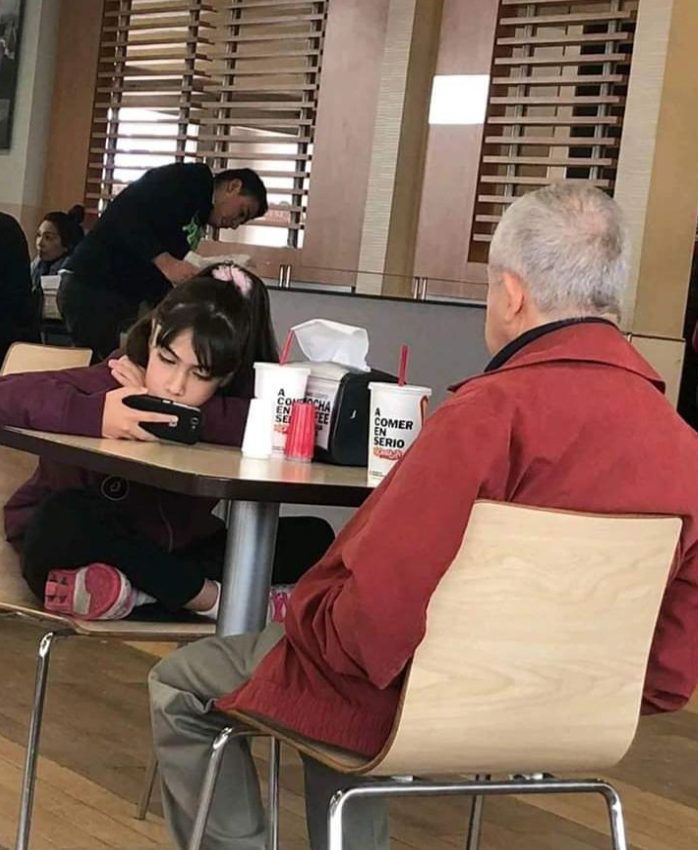
social media. The picture to the right (Figure 1) shows a little girl on a phone while what seems to be her grandparent simply stares at her. Although the context of this photo is not completely evident, this is very typical in this day and age, where the internet and social media is much more entertaining that having conversations with others, in this case, our own family. An article published by The Social Skills Center, which is a consulting company created by Clinical Psychologist, Dr. Christopher Haley, states, “Social media has displaced many of the opportunities participants would have had to practice face-to-face communication… This can exacerbate effects such as poor reading of body language, short attention spans, and more, particularly for younger users” (“How Does Social Media Affect Social Skills?”). It’s unfortunate to see that something created for us to connect with others has made us less social. However, the social aspect is not the only way social media has degraded our culture and society.
It would be easy to think that because social media is curated to our personal interests and following, that it would make us happy when we use it, right? Unfortunately, quite the opposite is true. Social media can negatively affect people’s mental health. Social applications such as Instagram, Facebook, and TikTok have been a breeding ground for unhealthy self-comparison and lowered self-esteem. Many posts and videos online only display people’s highlights, successes, and positive lifestyle, which doesn’t necessarily reflect reality. An article published on Medium perfectly describes how people display themselves on social media, in that, “it’s a collection of the most exceptional and attention-worthy moments (where) people rarely share their failures, setbacks, or moments of vulnerability” (“Unveiling the Illusion: Why Social Media Is Not Reality”). We may see a fitness guru with a six pack and 8% body fat online, which may make us feel jealous or inferior. But what we don’t see is the years of hard work, training, and mental battles he has had to endure just to reach that point. We may also see an 18 year old kid making $100,000 a year on social media, and feel like we are behind in life. However, we have no idea what his background is, who his parents are, or what experience he has. As a result of this false reality that people compare their lives with, this in turn can lead to mental health issues including depression, anxiety, and low self-esteem, which is common in the youth nowadays. The National Library of Medicine explains that “individuals who are involved in social media, games, texts, mobile phones, etc. are more likely to experience depression. The previous study found a 70% increase in self-reported depressive symptoms among the group using social media” (“Social Media Use and Its Connection to Mental Health”). The fact that 7/10 people in the study reported signs of depression after using social media shows how much of an impact it really has on our mental wellbeing.
While social media can have a negative impact on our social lives and mental health, one of its largest impacts is the effect on people’s education. One of the largest problems with social media is the spread of misinformation. Especially in a setting where information isn’t heavily regulated, social media also has been a breeding ground for misinformation. Content on social media is fueled more on opinions and emotions than the truth. In a study conducted by the USC involving over 2,000 active Facebook users taking a decision-making survey, researchers found that, “users’ social media habits doubled and, in some cases, tripled the amount of fake news they shared. Their habits were more influential in sharing fake news than other factors, including political beliefs and lack of critical reasoning” (Madrid). Taking in false information can be the cause of many negative consequences such as distrust or the loss of credibility of a person or group. A good example of this was the

opinions circulating the COVID-19 vaccine not only on the news but on social media as well.
The chart on the right (Fig. 2) displays the types of misinformation that people have heard or believed about the vaccine. As a result of all the misinformation floating around, many people who should have taken the vaccine ended up not taking it, which led to deaths or health concerns.
If social media has such a big negative impact on our lives, then what are some solutions? Dr. David Greenfield, a psychologist, professor, and founder of the Center for Internet and Technology Addiction, suggests, “tech companies should inform, educate, and provide technical resources to help people manage their technology use” (Greenfield). Some examples include screen warnings, information on its addictive nature, healthy use suggestions, treatment resources, and parental controls. On a more individual level, it’s important to be aware about the impact that social media has on our lives and work on minimizing the time we spend on these apps.
Social media is like a chain that imprisons us and keeps us complacent by endless scrolling

and a never-ending cycle of comparison. We must learn to break free from its grip and live a
life fueled by real-world experiences and meaningful relationships. After mustering enough willpower, I finally decided to put the phone down and do something I haven’t done willingly in a long time: help my mom out with her chores. It was a small gesture, but a sign that I had reclaimed my time and my priorities. Mom just looked at me and smiled. I was free.


Comments